Miqenekor
Lattice Map
Lattice Map
Couldn't load pickup availability
Share
1. Problem Statement
At a wider study stage, mobile development can feel difficult because every topic starts connecting with several others at the same time. A learner may understand screen layout, user actions, reusable blocks, and route movement separately, but still need help seeing how they form one larger structure. Multi-screen examples can become confusing when values move between screens, messages appear after actions, and lists change during a route. Review can also become harder when earlier ideas are not linked clearly with newer topics. Lattice Map was created for learners who want a broad course tier that connects mobile development ideas through one organized study framework.
2. Solution
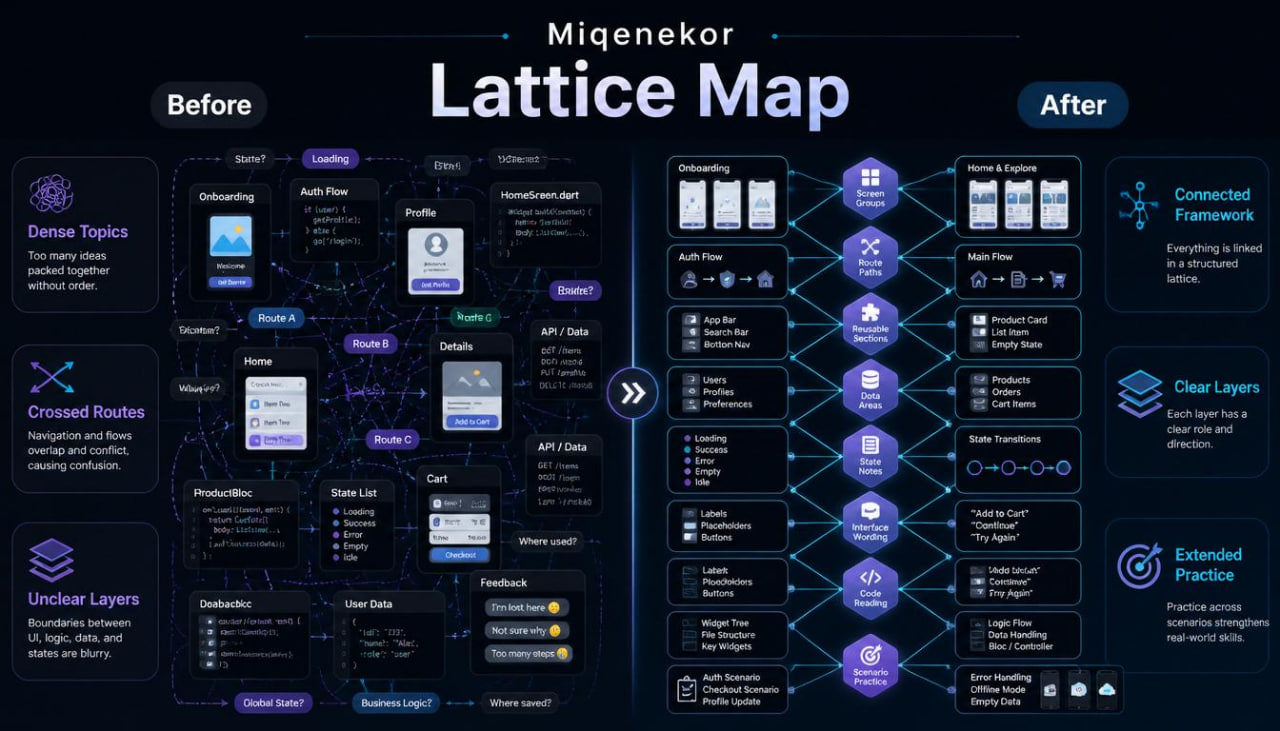
Lattice Map arranges wider mobile development topics into a connected learning structure built from modules, maps, examples, and review tasks. The course explains how screen routes, reusable sections, state changes, data display, and interface wording can work together inside larger mobile examples. Each module includes written explanations, text-based screen maps, code-style samples, and task prompts that guide learners through one part of the structure at a time. The tier uses repeated review so learners can return to earlier topics while studying wider examples. This course gives learners a broad Miqenekor study path without relying on exaggerated claims or pressure-based language.
3. What’s Inside
Lattice Map includes a detailed collection of digital learning materials for wider mobile development study. The tier is built around the idea of a lattice: separate learning points connected into a wider structure. Instead of treating each topic as isolated, the course shows how screen planning, route movement, data display, reusable blocks, and state changes can connect across several examples.
The first module introduces the lattice study structure. Learners receive a course map that divides the material into screen groups, route paths, reusable sections, data areas, state notes, interface text, code reading, and review tasks. This map shows how the tier is arranged and how each topic connects with nearby topics. Learners are encouraged to read the structure before beginning the modules, so they can see where each idea belongs.
The second module focuses on screen groups. A wider mobile example may contain several screen types, such as a starting screen, a list screen, a detail screen, an input screen, a review screen, and a settings-style screen. Lattice Map explains the role of each screen and how it can be described before code is studied. The module includes text-based screen sketches, section labels, and practical questions that ask learners to identify the purpose of each screen.
The third module studies route paths. Learners review how a person may move from one screen to another through choices, actions, and return steps. The course uses route examples such as list to detail, detail to edit, input to review, selection to summary, and review back to list. Each path is shown with a written route note, a carried value, and a visible result. Practice tasks ask learners to complete missing route steps and explain where information moves.
The fourth module focuses on reusable sections across several screens. Learners examine headers, rows, cards, input groups, message areas, detail blocks, and summary sections. The course explains how a reusable section can appear in different places while keeping a familiar structure. Each example includes a visible screen role and a code-style role, so learners can study both sides of the material. Exercises ask learners to name repeated sections, compare their placement, and explain how they support the wider course example.
The fifth module studies data areas. Mobile screens often display information through lists, labels, details, counters, summary blocks, or saved entries. Lattice Map shows how data can begin in one place, move through a route, and appear in another screen section. The material uses small scenarios to explain selected values, typed text, changed entries, and displayed summaries. Learners review where information starts, how it is carried, and where it becomes visible.
The sixth module focuses on state notes. A screen can be empty, filled, selected, edited, hidden, visible, updated, cleared, or waiting for input. Lattice Map explains these conditions through practical examples instead of abstract definitions. Learners study how state notes can be written beside a screen map to show what changes after each action. The exercises ask learners to connect a screen condition with a user action and a visible result.
The seventh module connects interface wording with wider screen examples. Learners study headings, labels, helper notes, action text, empty-state notes, and feedback messages. The course shows how wording can support a screen’s purpose, explain an input, describe a result, or guide a review step. Each wording example is connected to a screen section and a route point. Practice tasks ask learners to write calm interface text for sample screens and explain where each line belongs.
The eighth module studies code reading for wider structures. Learners examine code-style examples that include several screen sections, reusable blocks, values, actions, and display changes. The material breaks each example into layers: screen role, visible section, reusable block, carried value, action step, and result area. This helps learners study larger examples without treating them as one unreadable block. Each code-style sample includes notes that explain the role of names, grouping, and order.
The ninth module introduces connected scenario practice. Learners work through a small mobile scenario with a starting screen, a list, a detail view, an edit section, a message area, and a summary screen. The task is divided into several parts: read the screen map, identify reusable sections, describe the route, track the carried value, note the state changes, and label the code-style sections. This practice set brings together ideas from earlier tiers and places them into one wider study activity.
The tenth module focuses on comparison tasks. Learners compare two mobile flows and explain how their screen groups, routes, data areas, and feedback sections differ. One example may focus on selecting and viewing information, while another may focus on entering and reviewing information. The comparison format helps learners notice patterns across examples instead of memorizing one structure. These tasks are written as guided questions with space for plain-language answers.
The eleventh module provides review pages and reference notes. The recap sections gather terms from the full Miqenekor course collection and place them into connected groups. Terms such as screen group, route path, reusable section, data area, state note, carried value, feedback point, summary block, and code layer are explained in direct wording. Learners can use these pages while reviewing examples or completing tasks.
The twelfth module contains a final structured practice set. Learners receive a larger written scenario and work through it step by step. They create a text-based screen map, label screen roles, identify reusable sections, track values, write state notes, prepare interface text, and read a code-style example. The task is divided into smaller parts so learners can focus on one layer at a time. The goal is to bring the full Lattice Map structure together in a practical and organized way.
Lattice Map also includes a wider glossary, module recaps, screen map samples, route tables, state worksheets, and code-reading prompts. The materials are designed for repeated review, so learners can return to earlier sections when studying wider examples. The course keeps the Miqenekor style: written modules, calm explanations, practical exercises, and structured topic order.
4. Who Is This For?
Lattice Map is for learners who want the widest Miqenekor course tier and are ready to study connected mobile development materials in a broader format. It is suitable for people who understand earlier topics such as screen layout, user actions, reusable sections, state changes, data display, and route movement.
This tier may fit learners who want a full set of written modules, larger practice tasks, and deeper review sections. It is useful for learners who prefer studying through maps, tables, screen notes, code-style samples, and structured exercises. Lattice Map can also suit learners who have reviewed previous Miqenekor tiers and want a course that brings those ideas together into wider scenarios.
The course is written for steady study, not for dramatic claims. It focuses on organized learning materials, practical tasks, and mobile development concepts explained through connected examples.
5. What You’ll Learn
- How to study mobile development through a connected course framework.
- How to organize several screen types into screen groups.
- How to describe route paths between list, detail, input, review, and summary screens.
- How reusable sections can appear across several mobile examples.
- How data areas display selected values, typed text, changed entries, and summaries.
- How to track where information begins, moves, and appears.
- How to write state notes for empty, filled, selected, edited, visible, hidden, updated, and cleared screen conditions.
- How interface wording can connect with screen purpose and route movement.
- How headings, labels, helper notes, action text, and feedback messages fit into wider examples.
- How to read code-style examples by screen role, visible section, reusable block, carried value, action step, and result area.
- How to complete connected scenario tasks using maps, route notes, state worksheets, and code-reading prompts.
- How to compare two mobile flows and explain their structural differences.
- How to review a wider course through glossary pages, recap notes, and reference sections.
6. 30-Day Refund Window
Lattice Map is included in the Miqenekor 30-day refund window for eligible paid orders. Customers can send a request through the store contact page with order details if they need help related to a paid course order. The request is reviewed according to the store terms and the digital course format. This note is included so customers can understand the refund window before choosing this Miqenekor tier.
Self-paced learning overview
- 📄 Digital file available after purchase
- 🗂️ Long-term availability
- 🔒 Secure checkout
- 🗓️ Content updated in 2026
What format are Miqenekor courses provided in?
What format are Miqenekor courses provided in?
Miqenekor courses are provided as digital learning materials with written modules, code examples, practice tasks, review notes, and structured topic sections. The materials are made for self-paced study and can be reviewed in parts.
Do I need previous mobile development knowledge?
Do I need previous mobile development knowledge?
No previous mobile development background is required for the starting tiers. The early materials begin with basic ideas, simple code structure, screen logic, layout thinking, and small practice tasks.
Can I study at my own pace?
Can I study at my own pace?
Yes. Miqenekor courses are arranged so learners can move through the materials gradually, repeat sections, and return to examples when needed.