Miqenekor
Vertex Guide
Vertex Guide
Couldn't load pickup availability
Share
1. Problem Statement
Once learners understand screen layout, user actions, feedback messages, and changing information, they often meet a new challenge: mobile development rarely stays inside one screen. A simple idea may begin with a list, move to a detail view, collect input, show a message, and return to another screen with changed information. This can feel difficult when each part is studied separately and the learner does not yet see how the parts form one connected structure. Another common issue appears when repeated sections and values need to be reused across several screen examples. Vertex Guide was created for learners who want a more organized way to study connected mobile structures without losing sight of the smaller parts.
2. Solution
Vertex Guide presents connected mobile development topics through written modules, practical examples, screen maps, and code-reading tasks. The course explains how several screen ideas can be connected through routes, shared sections, reusable blocks, and simple stored values. Each module begins with a plain-language scenario, then moves into a screen outline, a code-style example, and a review activity. The course keeps the Miqenekor approach: structured study, clear explanations, practical tasks, and steady topic order. It gives learners a wider view of mobile development while keeping each concept divided into readable sections.
3. What’s Inside
Vertex Guide includes a detailed collection of learning materials focused on connected screens, reusable logic, screen routes, shared information, and multi-step study examples. It builds on earlier Miqenekor tiers by taking screen planning, interaction behavior, and interface details into broader course scenarios.
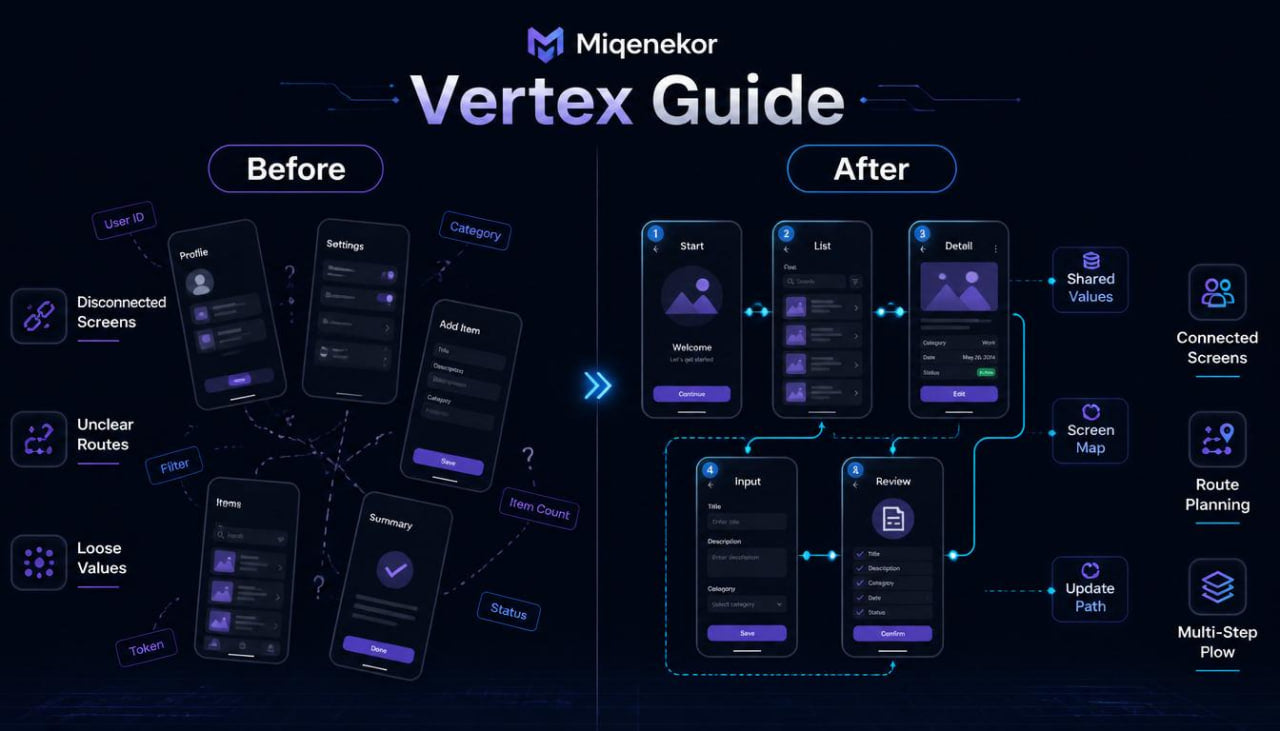
The first module introduces connected screen thinking. Learners review how one screen can lead to another and how each screen can have a different role inside a larger flow. A starting screen may introduce a list, a detail screen may show selected information, an edit-style screen may collect input, and a review screen may display a result. The module explains these ideas with text-based screen maps and short notes that show how each screen connects to the next one.
The second module focuses on route planning. A route is presented as the path between screen ideas. Learners study how a user can move from one section to another, what information may need to move with them, and how to describe that path before looking at code. The course uses simple route examples such as list to detail, form to review, start screen to settings-style screen, and item selection to display section. Each route includes a written explanation and a practice prompt.
The third module introduces shared values. In mobile development, information often needs to be used in more than one place. Vertex Guide explains this with beginner-friendly examples: a selected item, a typed name, a chosen category, a saved note, or a status value. Learners study how shared values can be described in plain language before being shown in code-style form. The materials focus on the idea of where information comes from, where it moves, and where it appears.
The fourth module studies reusable screen sections across several screens. Earlier tiers showed repeated blocks inside one screen. Vertex Guide expands that idea by showing how a header area, list row, detail block, input group, or message area can appear in several screen examples. The course explains why repeated sections should be named carefully and studied as separate pieces. Learners review examples where one reusable block appears in different screen contexts while keeping its main structure.
The fifth module focuses on screen maps. A screen map is a planning note that shows the relationship between several screen ideas. Learners review small maps that include a starting screen, a list screen, a detail screen, and an action screen. The goal is to help learners see the full course scenario before reading code fragments. Practice tasks ask learners to draw a text-based map, label each screen role, and describe the path between them.
The sixth module introduces multi-step user flows. Learners study how several actions can create a longer sequence: choose an item, open details, edit information, show a message, and return to a previous screen. The material breaks each sequence into small steps so the learner can study one movement at a time. Each example includes a flow note, a screen summary, and a code-style section with explanation.
The seventh module studies information updates across screens. A learner may understand how one screen changes, but it can be harder to understand what happens when a value changes in one place and appears in another. Vertex Guide explains this through simple scenarios involving selected items, updated labels, changed lists, and review screens. The course keeps the examples readable and avoids large technical structures. Learners focus on what changes, where it changes, and which screen shows the result.
The eighth module focuses on code organization for connected examples. The materials show how code-style sections can be divided by screen role, shared value, repeated block, and action function. Learners review how naming, grouping, and section order can make a connected example easier to study. The course encourages reading code in layers: first the screen map, then the visible sections, then the shared values, then the user actions, and then the visible result.
The ninth module includes guided practice tasks. Learners complete screen map exercises, route-matching tasks, shared value questions, reusable block reviews, and code-reading prompts. Some tasks ask learners to identify which screen owns a certain action. Other tasks ask them to decide where a value begins and where it appears later. The goal is to make connected screen study more organized through repeated practice.
Vertex Guide also includes recap pages and a broader glossary. The glossary includes terms such as screen route, shared value, connected flow, reusable section, screen map, selected item, detail view, review screen, and update path. Each term is explained in plain language and placed near related examples. The recap pages are designed for review after each major module, so learners can return to the main ideas before moving further.
4. Who Is This For?
Vertex Guide is for learners who already understand single-screen structure and want to study how several mobile screen ideas connect. It is suitable for people who have reviewed earlier Miqenekor tiers and want to move into screen routes, shared information, reusable sections, and longer user flows.
This tier may also fit learners who can read smaller code examples but feel unsure when the material includes several screens at once. It is written for people who prefer organized written modules, screen maps, practical tasks, and review notes.
Vertex Guide is also useful for learners who want to study mobile development in a more connected way. Instead of focusing only on one button, one field, or one message, this tier shows how several interface parts can work together inside a larger course example.
5. What You’ll Learn
- How to study several connected mobile screens as one learning structure.
- How to describe routes between screen ideas in plain language.
- How shared values can move from one screen section to another.
- How selected items, typed text, saved notes, and status values can appear in several places.
- How reusable sections can be studied across several screen examples.
- How to create a text-based screen map for a simple mobile flow.
- How to label screen roles such as starting screen, list screen, detail view, input screen, and review screen.
- How to break a multi-step user flow into smaller actions.
- How information updates can affect more than one screen.
- How to read code-style examples by screen role, shared value, repeated block, and action section.
- How naming and grouping can make connected examples easier to review.
- How to use recap pages and glossary notes during broader mobile development study.
- How to prepare for wider Miqenekor tiers that include larger structures and deeper practice sets.
6. 30-Day Refund Window
Vertex Guide is included in the Miqenekor 30-day refund window for eligible paid orders. Customers can send a request through the store contact page with order details if they need help related to a paid course order. The request is reviewed according to the store terms and the digital course format. This note is included so customers can understand the refund window before choosing this Miqenekor tier.
Self-paced learning overview
- 📄 Digital file available after purchase
- 🗂️ Long-term availability
- 🔒 Secure checkout
- 🗓️ Content updated in 2026
What format are Miqenekor courses provided in?
What format are Miqenekor courses provided in?
Miqenekor courses are provided as digital learning materials with written modules, code examples, practice tasks, review notes, and structured topic sections. The materials are made for self-paced study and can be reviewed in parts.
Do I need previous mobile development knowledge?
Do I need previous mobile development knowledge?
No previous mobile development background is required for the starting tiers. The early materials begin with basic ideas, simple code structure, screen logic, layout thinking, and small practice tasks.
Can I study at my own pace?
Can I study at my own pace?
Yes. Miqenekor courses are arranged so learners can move through the materials gradually, repeat sections, and return to examples when needed.